- Only five channels reliably send traffic to a B2B website, and two of them are too slow to show anything for at least two quarters.
- Benchmark against a website of similar age and niche — a global average tells a small business nothing it can use.
- Content without distribution is the single most expensive mistake a marketing team makes.
- One authority signal — earned coverage that carries a link — is worth more than fifty website pages nobody reads.
- Use two tools, never one: each tool shows a different slice of the same website.
- SEO carries most of the load for any site that cannot fund ads forever — but it is far too slow to rescue a deadline.
How much web traffic does a site get, realistically?
This is the first question worth answering, because without a reference point every other marketing decision becomes guesswork. And the honest answer is that averages are useless here: a five-page brochure for a local business and a mature SaaS platform are both "a site", and the gap between them runs to four orders of magnitude.

What does help is comparing against websites of a similar age, niche and commercial model. The bands below reflect what our analysts see across roughly 180 B2B accounts. Treat them as directional, not as targets — use them to get a sense of whether a number is disappointing or entirely normal for a website at that stage, on a site of that age.
| Stage | Monthly traffic | What is usually driving them |
|---|---|---|
| New website, 0–6 months | 100–800 | Brand searches, outbound, a handful of referrals |
| Established SME site, 1–3 years | 1,000–8,000 | A dozen ranking pages plus direct traffic and email |
| Scale-up with a content engine | 15,000–80,000 | Fifty or more ranking pages, a link base, paid ads |
| Category-leading website | 250,000+ | Brand demand, a large library, strong link profile |
Two things stand out. The first is how modest the early traffic is — a new business website doing 400 sessions a month is not broken, it is simply new. The second is that every jump between bands comes from the same two inputs: more pages worth reading, and more reasons for other websites to link to them. There is no third input that quietly does the work.
Worth noting
Session counts in analytics are not the same as the estimates a rank tool publishes about your website. A tool like Similarweb models visits from panel data and will often differ from your own numbers by a wide margin, in either direction. Use both, and treat neither as the single source of truth.
The five channels that send traffic to a website
Strip away the tactics and there are only five ways somebody arrives on a website. Every list of "37 ways to get traffic" is a reshuffling of these, and knowing which one a given tactic belongs to makes it far easier to work out whether it deserves the next month of marketing effort.
1. Organic search
Someone types a query and lands on a page. Organic search is the largest source for most B2B websites, and for a young site it is also the slowest to build, because it depends on content, SEO and authority together. It is the only channel that keeps working when the marketing team stops touching it, which is why nearly every serious plan is built around it.
2. Direct and brand
People who already know the business type the website address in, click a bookmark, or search the brand name. Direct is a lagging indicator of everything else — it grows when a business becomes known, so no marketing plan can attack it head-on. A healthy direct share is a sign that the other channels are working too.
3. Referral
A link on another website sends someone across. This is the channel marketing teams underrate most: a single mention in a trade publication or a partner directory can send more qualified traffic in a week than three months of publishing. Referral is also how a link profile gets built, so it pays twice.
4. Social and community
Posts, comments, newsletters shared in Slack groups. Social sends bursts rather than a baseline, and reach depends entirely on an audience that already exists. For a new business the honest expectation is close to zero until that audience is built, which takes as long as anything else on this list, too.
5. Paid
Ads on search, social or display. Paid is the only channel that produces traffic on day one, and the only one that stops the moment the budget does. It is a discovery tool more than a growth engine — use it to find out which offers and pages convert before committing content effort to them.
The sequencing question
Small teams fail by running all five at once. Pick one compounding channel — almost always SEO — and one fast channel that suits the business, then leave the rest out for two quarters. Four channels run badly turn out worse than one run properly.
SEO and content: the foundation, and why it is too slow to rush
If a website is going to attract traffic without a permanent advertising budget, SEO has to carry most of the load. That makes it less a marketing speciality than a structural requirement for the whole business — and it explains why the timeline is measured in quarters rather than weeks.
The mechanics are unglamorous. A search engine needs to find a page, understand what question it answers, and decide it is a better answer than the website pages already ranking. The first two are technical SEO and largely solvable in a fortnight. The third is competitive, and it is where almost all the time — and most of an SEO budget — goes.
Commercial pages before blog content
The most common ordering mistake — and it is far too common — is starting with a blog. Blog content builds authority and catches early-stage questions, but it rarely converts, and it is too easy to mistake published volume for progress, and a business with no ranking commercial pages has nothing for that authority to support. Build the pages that describe what you sell first, then write content that gives search engines a reason to trust the website they sit on.
For a small website that usually means somewhere between six and fifteen commercial pages — one per service, one per major use case, one per market you sell into. Many more than that on a small site and the pages start competing with each other, too. Each needs to answer the buying question completely, because a thin page will not outrank a thorough competitor on a bigger site no matter how many internal links point at it. Use one page per question, and say everything on it. That is how a website starts to get traffic that does not depend on a budget.
What good content actually requires
Content people actually use is expensive, and pretending otherwise is why so many content programmes quietly die in their third quarter. A single substantial article needs a subject-matter interview, a writer, an editor and a round of revisions. Publishing weekly at that standard is a full-time marketing role — so most SMEs turn out better publishing monthly and doing it properly.
A workable content checklist, in order:
- Write down the ten questions prospects ask on a first call. These are your first ten pieces, and they turn out better than anything invented in a keyword tool.
- Find out what already ranks for each. If the top results are thin, that is your opening; if they are exhaustive, pick a narrower angle.
- Publish the commercial page first, then the supporting content that links to it. Use the words buyers use, not the words the industry prefers.
- Add an internal link from every new piece back to the relevant commercial page. It is free, it works, and it is routinely left out.
- Revisit anything that stalls after two quarters. Updating an existing page usually beats writing a new one.
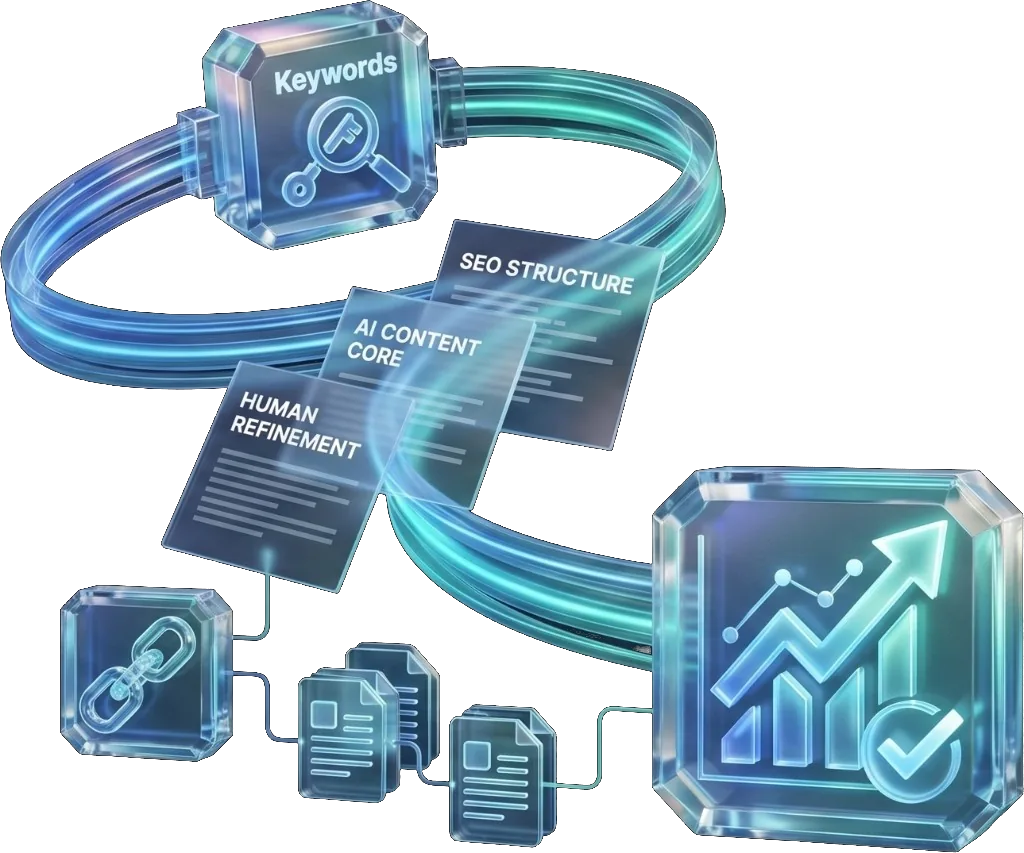
Notice how little of that list is about volume. Teams that treat content as a word-count target end up with fifty pages and no rankings; teams that treat it as a set of answers to real questions end up with fifteen pages and a pipeline. The difference is not effort — it is whether the work was aimed at a business outcome or at an output metric.
One more thing trips up marketing teams: SEO and content are the same project, not two. A content calendar with no SEO input produces website pages nobody searches for, and an SEO plan with no content behind it produces a keyword list and no pages. Teams that split the two between different owners tend to find out the hard way, about nine months in, that neither half works on its own.
No in-house writer? Our blog content generation service produces the library, briefed on your own buying questions rather than a generic keyword list.
See how it works →Authority: why one good link beats fifty pages
Content answers the question; authority decides whether a search engine believes your website is a credible place to find that answer. In practice authority is built through link building — earning references from other websites — and it is the hardest part of the job to fake convincingly.
The word "link building" covers wildly different activities, and the gap between them matters commercially. Earned coverage in a publication your buyers actually read is worth an enormous amount, and it sends traffic too. A link from a directory nobody visits is worth close to nothing, and a purchased link from a site built purely to sell them is a liability. The same label, three completely different outcomes.
| Approach | Realistic effort | What it is worth |
|---|---|---|
| Earned press or industry coverage | High — needs a genuine story | Very high, and sends referral visitors too |
| Guest articles on relevant websites | Medium — one per week is realistic | Solid, if the host website has a real audience |
| Partner, customer and supplier pages | Low — mostly asking | Modest but easy, and too often left out |
| Directories and listings | Low | Near zero, beyond a few industry-specific ones |
| Bulk purchased links | Low | Negative — a risk to the whole website |
The practical advice for a small business is narrower than most guides suggest: use the available hours on the top three rows and leave the rest out entirely. Ten strong links beat two hundred weak ones, and the weak ones carry a cleanup cost that nobody budgets for — usually too late to negotiate.
One more point that gets lost. A link is not only a ranking signal — it is a road. People click. If a mention appears somewhere your buyers already spend time, the referral traffic it sends is frequently better qualified than anything SEO brings in that quarter, and it arrives with the credibility of the host publication attached.
Two habits make link building tractable for a small marketing team. Use a tool to pull the links a competitor has and you do not — that list is your prospect list, and it costs nothing. Then set out one story a quarter worth covering: a data set, a benchmark, a customer result. Both habits are boring, and both work better than sending out a hundred cold outreach emails.
Building authority deliberately? Ahrefs DR link building and our guest post service both work on placements with real audiences, not directory dumps.
Authority services →Measurement: which tool tells you what
You cannot manage a channel you cannot see, and every tool lies slightly differently. Using two tools is not redundancy — it is the only way to notice when one of them is wrong.
Your own analytics
Google Analytics is the ground truth for what happened on your website: sessions, channel groupings, engagement, geography. It is also the tool most often misread. Channel groupings are guesses, "direct" is a catch-all for anything without a referrer, and a tracking gap can quietly delete a week of data. Use the acquisition report monthly, not daily — daily numbers are noise.
Search Console
The only place that shows which queries your website appears for, and at what position. Impressions rising while clicks stay flat is the early signal SEO teams use most: it means search engines have started trusting the pages, and titles are the next thing to fix.
Rank and estimate tools
Similarweb, Semrush and Ahrefs each model your website traffic from a distance, which is precisely why buyers, investors and partners use them — they can check those numbers without asking for access. Their figures will not match your analytics, and each tool disagrees with the others too. What matters is the trend and the comparison against competitors.
A minimum measurement set-up:
- Analytics installed correctly, with the conversions you actually use defined — a form submission counts, a page view does not.
- Search Console verified, with the sitemap submitted and coverage errors reviewed monthly.
- One external tool checked quarterly, mostly to find out what an outsider sees when they look up the site. Pick the tool your buyers use, not the tool you like.
- A single monthly marketing report anyone in the business can read without a walkthrough.
That last item does more work than it appears to. A number nobody outside the marketing function understands will not survive a budget review, and no business gives a channel the eighteen months it needs to compound on faith alone.
When buying visitors makes sense — and when it does not
Everything above earns traffic through marketing work. There is a separate category that purchases it, and that deserves a straight assessment rather than either an endorsement or a dismissal.
Start by ruling out what it cannot do. Bought traffic does not become customers. Nobody arriving through a traffic service is going to request a demo, so any provider promising conversions from purchased visits is describing something that does not exist. If revenue is the goal, the answer is SEO, content, authority and a functioning sales motion — there is no shortcut, and this guide is not going to invent one.
What purchased visits do change is how a website appears to people who check before engaging. Investors open Similarweb during diligence. Prospective partners look at whether a website seems alive. Procurement teams weigh whether a supplier is substantial enough to depend on, and a thin site reads as a small supplier. Those judgements happen off the back of numbers a business cannot influence quickly through content, because content takes quarters and a funding round does not wait.
| Situation | Sensible? | Why |
|---|---|---|
| Rank or visibility needs to move before a raise or partnership review | Yes | The timeline is fixed and content cannot compress it |
| A new website looks abandoned to anyone who checks | Yes | Removes an objection while the real channels build |
| Testing which pages hold attention, at volume, quickly | Yes | Produces engagement data months before SEO would |
| Hoping for leads or sales | No | Purchased visits do not convert, and never will |
| Replacing SEO and content entirely | No | Nothing compounds; the moment you stop, it is gone |
The distinction that matters is quality of delivery. Cheap panels serve scripted hits from datacentre ranges: two-second visits, nonsensical geography, an engagement profile any analyst spots in a minute. A managed service delivers human sessions on residential connections, against a written profile covering geography, device and behaviour — the difference between a number that survives scrutiny and one that creates a new problem. For a business that will be checked that gap matters, and it is far too easy to get wrong when the only thing being compared is price.
If a deadline is the constraint, targeted website traffic is scoped in writing first — geography, behaviour band and reporting — with a free audit before anything is agreed.
How delivery works →A ninety-day plan for a small team
Advice is easy to agree with and hard to sequence. Here is the ordering our analysts recommend to SMEs, scale-ups and the agencies running this on a client's behalf, assuming one marketing owner with perhaps a day a week to spend.